
Standards get updated every few years. When a new version comes out, the EU doesn’t switch overnight. It gives the old version an end date, so manufacturers have time to test their products again. Four of those end dates fall on 16 November 2026, two weeks from today. (They were set in June, in Decision (EU) 2026/1279.)
The four standards
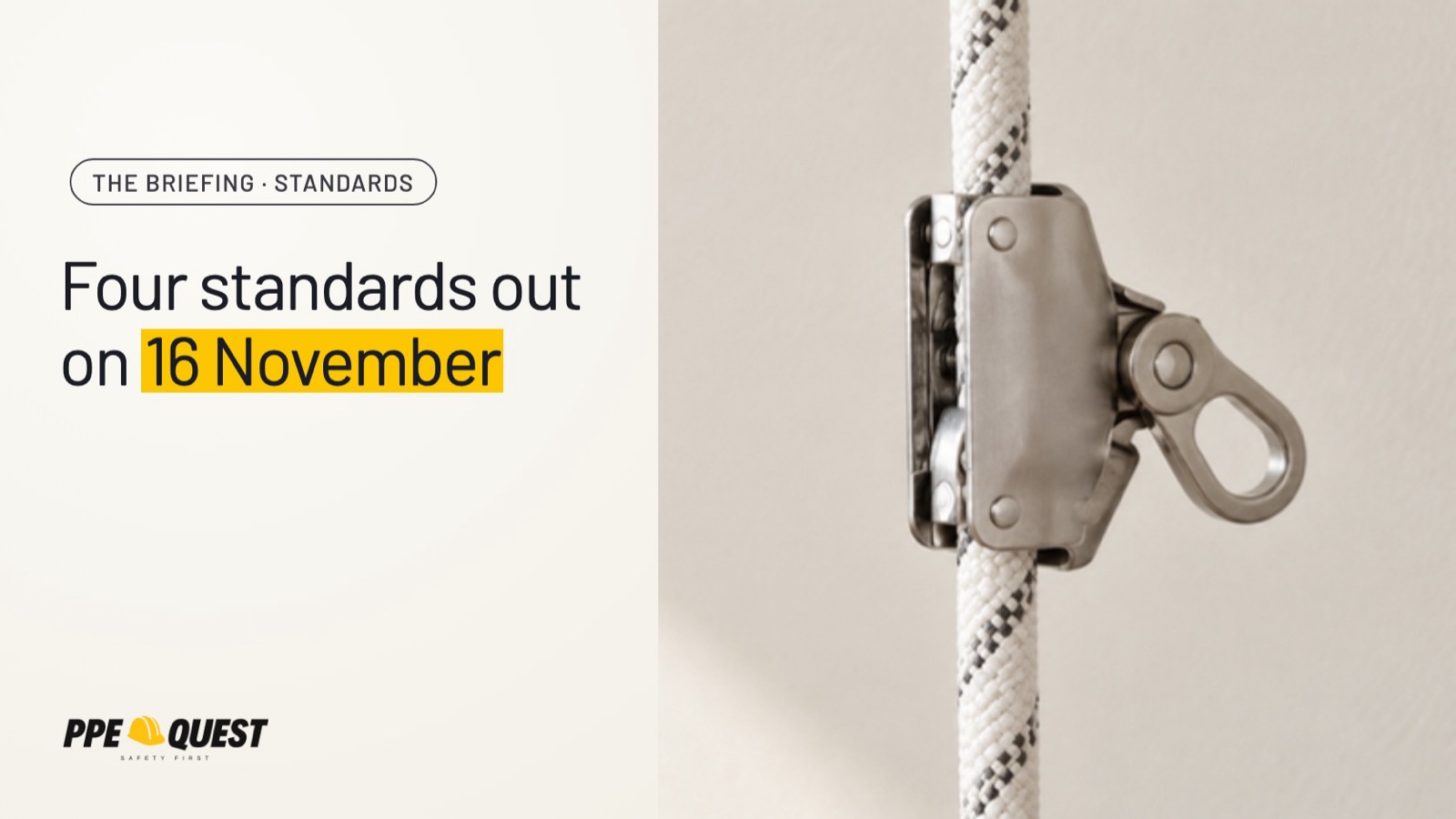
- Rope grabs (EN 353-2). A rope grab is the device that slides along a vertical safety rope and locks if you fall. You find them on ladders, towers, masts, wind turbines and scaffolding. The 2002 version of the standard is replaced by the 2024 one, and most of what’s new is in the testing:
- Wet and cold. For the first time, the lab checks that a rope grab still locks properly when it’s soaking wet and when it’s freezing. That’s how they’re often used outdoors.
- Not just straight up. The new version has tests for ropes that run at an angle, and for horizontal ropes, which can even be anchored at the user’s feet.
- Tougher overall. According to the test lab USB Lab, it’s also stricter on rust, strength and durability.
- Earplugs (EN 352-2). The update only changes the rules for banded earplugs, the ones on a band you hang around your neck. It adds rules for how well they fit and adjust when the band is worn over the head, behind the head or, especially, under the chin. Normal foam and reusable earplugs aren’t affected.
- Via ferrata lanyards (EN 958). Via ferrata routes are mountain routes with a fixed steel cable. Climbers clip into the cable with a shock-absorbing lanyard that softens the jolt if they fall. The 2024 version changes a lot, mostly in the testing:
- A new drop test. The lab uses a new test rig and method, a different test weight, and a different limit for the jolt the lanyard may pass on to the body.
- Clear weight range. The lanyards are for people from 40 kg, up to 120 kg including all their gear.
- More in the instructions. They now cover disinfecting the lanyard, and recommend that children also climb as part of a roped team.
- Rope courses (EN 17109). The safety systems in high ropes courses and adventure parks, the ones that keep visitors clipped in from start to finish. This one is a smaller amendment: a new test checks that the clips and trolleys work with the supports that hold the safety line, a deformation test now covers more types of device, and the manufacturer’s instructions are updated.
Great Britain uses the same date for all four.
What it means in practice
First, the good news: you don’t have to throw away gear you already use. A rope grab that’s in use today can stay in use, as long as it passes its regular inspections.
What changes is this. From 16 November, a new product can’t use the old version of the standard to prove it’s safe for the EU market. It has to meet the new one.
For most of you, rope grabs are the one that matters. They’re used every day in construction, telecoms and wind energy, and they’re the kind of product where nobody wants a discussion about certificates after an accident.
Sources: EUR-Lex, Decision (EU) 2026/1279, Annex II · GOV.UK, notice 0142/26 · USB Lab on EN 353-2:2024 · STN preview of EN 352-2:2020+A1:2024 · 3M Technical Bulletin on EN 352 · STN preview of EN 353-2:2024 · DIN, EN 353-2:2024 contents · STN preview of EN 958:2024 · STN preview of EN 17109:2020+A1:2024


 Canada

 Australia