

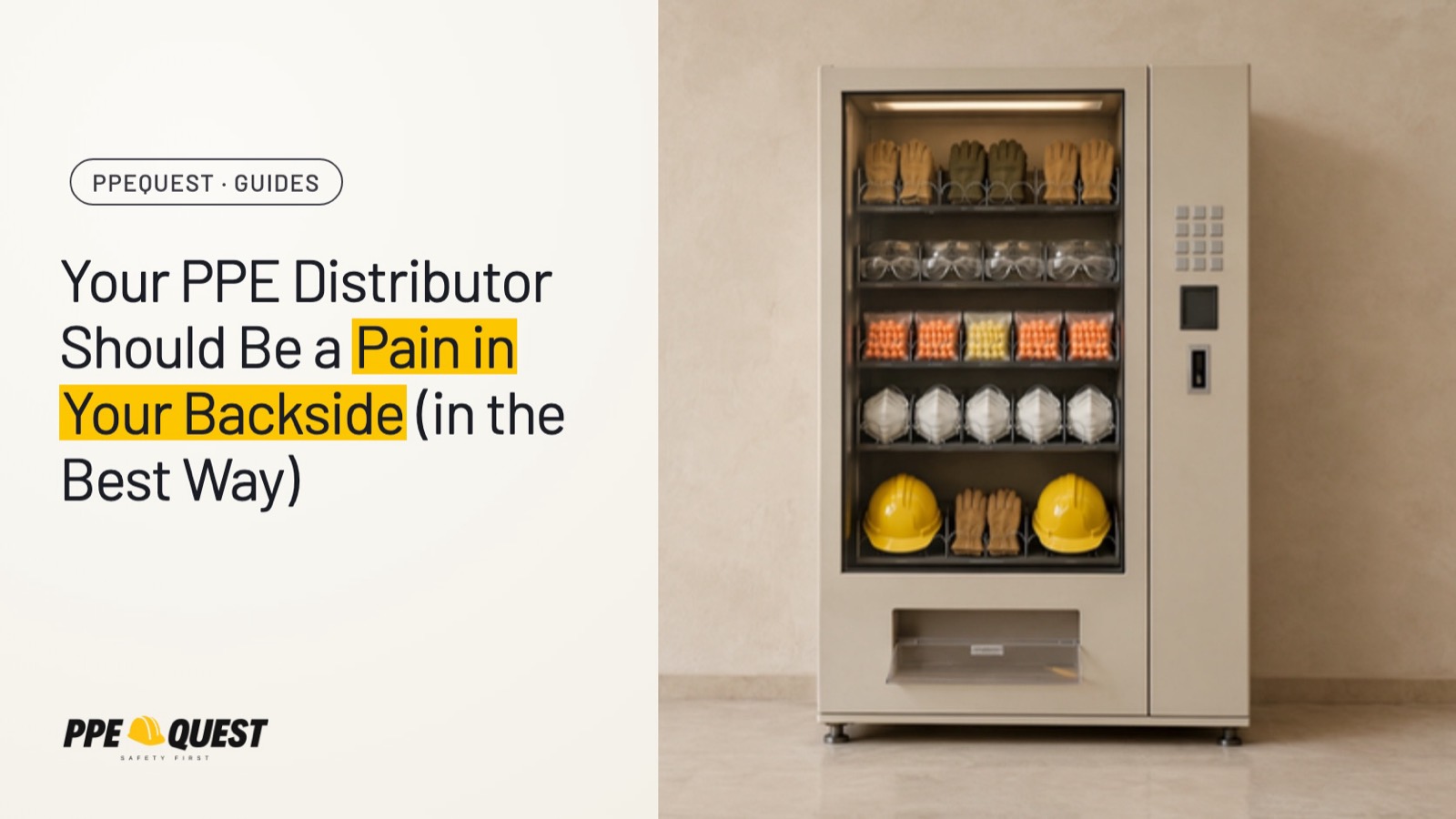
If your PPE supplier just drops off boxes and sends invoices, you don’t have a supplier.
You have a vending machine with a logo.
And to be fair – there’s nothing wrong with a vending machine when all you need is a vending machine. Sometimes you know exactly what you want, you reorder it, it turns up. Lovely. But if that’s the entire relationship, you’re paying a distributor’s margin for a postal service. And you’re missing the part where a good one quietly makes your whole programme better, safer and cheaper.
(Full disclosure: I spent years on the supplier side of this industry. So yes, I have opinions. Lots of them.)
What a partner actually does
A real distributor does far more than move product from a shelf to your stores. Here’s the work a good one should be offering you – often as part of the deal, not as a surprise line on the invoice.
- Fit testing on your site. A seal on a spec sheet means nothing until it’s tested on a real face. In many countries – the UK and the US among them – tight-fitting respirators have to be fit tested on the person who wears them. Even where it isn’t a legal must, it’s the only way to know the mask actually works on that face. A good partner helps you do it and keeps the records.
- Wear trials before you commit. Nobody should buy 500 pairs of anything on the strength of a photo. A sample, a few weeks on the real job and honest feedback from the people wearing it will save you from a very expensive standardisation mistake.
- Training on correct use. The right product worn wrong protects no one. Insertion technique, inspection, storage, when to bin it – that knowledge is part of what you’re paying for.
- Walking your floor. The gap between what’s issued and what’s actually worn is where your risk lives. A partner goes and looks, and tells you the truth about it. (Even when the truth is awkward.)
- Managing stock. The right products in the right sizes, so nobody is caught short mid-shift and tempted to “just do this one without”.
- Helping you rationalise. Most organisations carry far more product lines than they need. Consolidating sensibly cuts cost and confusion at the same time.
- The unglamorous logistics. Dispensing solutions, returns, end-of-life and recycling routes, and a heads-up when a standard changes under your feet.
The real test
The best distributors I’ve worked with all have one thing in common: they’ll talk you out of a sale.
You come in ready to spend more on a fancy glove, and they ask what the task is. Then they tell you it’s the wrong glove and point you at something cheaper that actually fits the work. They leave money on the table to get the protection right.
That’s the test.
A box-shifter sells you what you ask for. A partner asks why you’re asking. One optimises for this order. The other optimises for you still being a happy, uninjured customer in five years.
And the maths works in your favour, because a good distributor usually pays for themselves. Fewer wrong purchases. Less waste. Gear that actually gets worn. Fewer incidents. Fewer duplicate lines. None of that shows up on a single invoice – which is exactly why the cheapest-per-box supplier can quietly be the most expensive relationship you have.
From 9 December, it’s not just good service
There’s one more reason to want a partner rather than a postal service, and it arrives on 9 December.
That’s when the EU’s new product liability rules take over, for products placed on the market from that date. If a product made outside the EU hurts someone and no responsible company in the EU can be found, the injured person can ask the distributor who supplied it. The distributor then has one month to name its own supplier, or a responsible company in the EU. If it can’t, it can be held liable itself. Online marketplaces can be caught by the same rule.
A good distributor knows exactly where every product on its shelf comes from, and can show it in writing. A vending machine with a logo might not.
So add one question to your list: if something went wrong with this product, could you tell me within a month who made it and who brought it into the EU?
(The full story, with the sources, is in The Briefing No. 3.)
How to find out which one you’ve got
If your supplier has never once questioned an order, never offered a trial and never set foot on your floor, that’s not a partner. However nice the rep is on the phone.
So try this. Ask your supplier for a fit-test day, a wear trial or a walk round your site. Then watch how they react.
Their answer will tell you everything you need to know.
And if you are the distributor…
I know a lot of you read PPEQuest. (Hello! 👋)
This is your advantage. Anyone can sell a box of gloves – and increasingly, anyone does, with free delivery and a “buy now” button. What the online marketplace can’t do is stand on a customer’s shop floor, look at the task and say “not that one, this one”.
And from 9 December, being able to name your supplier for every product, within a month, isn’t just good service. It’s your own protection.
Be the pain in the backside. It’s the best business model you’ve got.


